Blog
AI is here. How secure is your financial data?
In the world of financial services, the race to adopt AI has created a tension between innovation and security. As firms leverage new AI tools to gain a competitive edge, they risk exposing vast amounts of sensitive financial data, creating significant compliance and security vulnerabilities.
To securely embrace AI, firms must have a clear understanding of who and what—including humans, machines, and AI agents—has access to business-critical data. By integrating adaptive data access controls, you can establish a foundation of least privilege and protect your most sensitive information, no matter where it resides.
Top data security challenges in financial services
The financial services sector is governed by a stringent set of regulations that make protecting sensitive data a legal and business imperative. Frameworks like the Financial Services AI Risk Management Framework (FS AI RMF) and the NIST Cybersecurity Framework (CSF) 2.0 provide critical guidance for establishing robust security and governance programs. They help organizations navigate the complexities of discovering and protecting sensitive data. Key regulations that also must be addressed include:
- Sarbanes-Oxley Act (SOX)
- Payment Card Industry Data Security Standard (PCI DSS)
- Gramm-Leach-Bliley Act (GLBA)
- General Data Protection Regulation (GDPR)
The core challenge is balancing the need for rapid data access with the mandate to safeguard sensitive information at scale, as outlined by these modern security frameworks and regulations.
How SailPoint helps secure data for the AI era
SailPoint Data Access Security helps address these challenges by providing deep visibility, data context, and automated governance workflows. The process is straightforward:
| Discover | Automatically scan and classify sensitive structured and unstructured data across your enterprise. |
| Contextualize | Merge identity and data context to get a clear picture of who and what has access to sensitive information. |
| Monitor | Keep a close watch on risky data access and anomalous user behavior across humans, machines, and AI agents. |
| Remediate | Improve access models by surgically removing excessive or unnecessary permissions without disrupting work. |
| Streamline | Simplify governance and forensics for audits with comprehensive, on-demand reporting. |
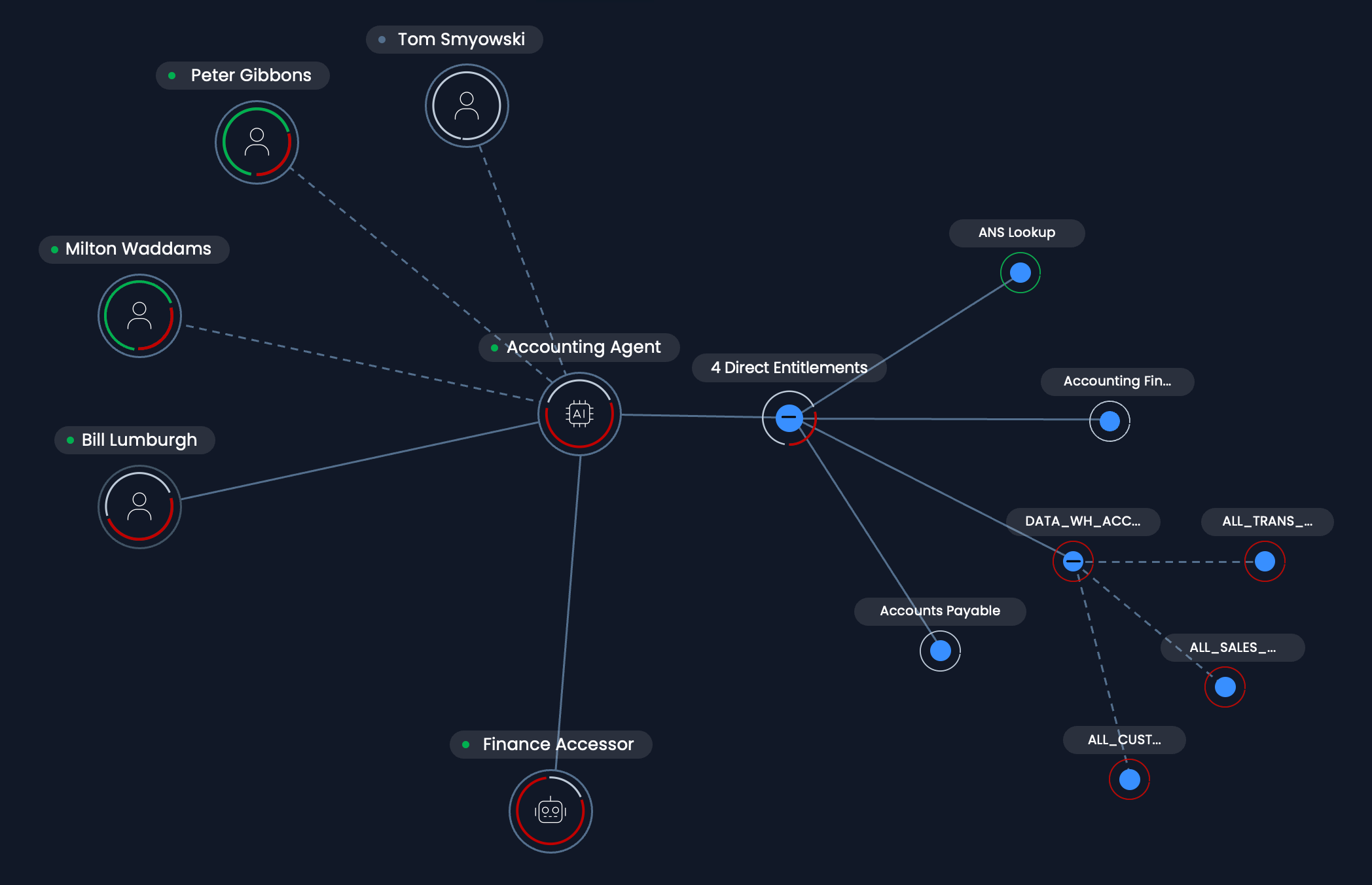
Visualize, contextualize, and remediate high-risk data access.
Put identity-centric data security to work
Here are four ways to leverage SailPoint Data Access Security to keep sensitive data safe:
| Use case | How SailPoint helps |
|---|---|
| Secure contractor access to data | A consultant is granted temporary access for a sensitive M&A project. When the project ends, SailPoint automatically revokes sensitive data access to prevent lingering permissions and provides a full audit trail of the consultant’s activity to ensure compliance. |
| Remediate risky access | An audit reveals that a junior analyst has access to a SOX-critical folder. SailPoint visually maps the complex data access path, revealing the permission was inherited through nested groups. This allows you to remove the permission at its source with automated workflows. |
| Automate governance & compliance | Instead of frantic, manual fire drills related to compliance, SailPoint generates comprehensive reports on demand. This provides a detailed audit history of who has access to what, empowering data owners to make compliant access decisions. |
| Accelerate secure AI adoption | By providing a secure foundation for sensitive data access, you can confidently pursue AI initiatives, from developing personalized customer experiences to leveraging new models, knowing that critical information is kept safe. |
Securely innovate with AI
The risk of an AI-driven data leak is real. Consider a new AI-powered analytics tool that is granted overly broad access to a file storage system containing both market research and sensitive M&A documents.
SailPoint Data Access Security helps you:
- Discover and classify the sensitive M&A data
- Identify an identity’s excessive permissions
- Provide the context needed to right-size access
This proactive approach allows you to help prevent a potential AI-driven data breach and ensure you are innovating safely and responsibly.
Ready to get started?
- Download the data sheet Data Access Security for financial services