Blog
PHP2Shell: Patching is step one. Containment keeps you afloat.
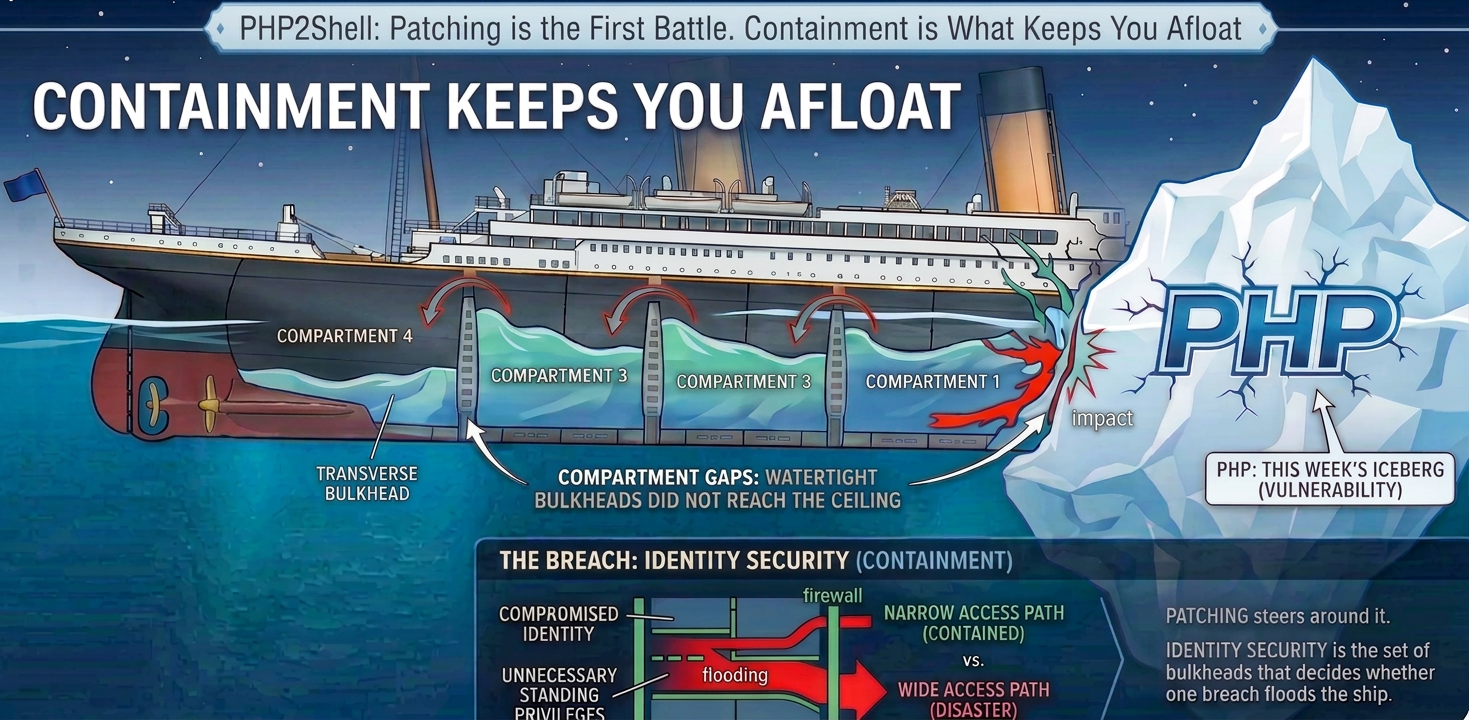
The Titanic was split into watertight compartments, but the walls between them didn't reach the ceiling. Once one compartment filled, the water spilled into the next, and one breach became a disaster. PHP2Shell (CVE-2026-109618 and CVE-2026-109619) is this week's iceberg. The real question is not whether you will hit one, but whether the controls around it have gaps.
Somewhere right now, a security engineer is asking the question nobody enjoys: "Wait, where do we run PHP?" It is a fair question, because PHP2Shell is one in question. Two flaws in PHP, disclosed October 21, let an attacker send a crafted web request to an unpatched server and run their own commands without logging in. The PHP advisory rates both 9.2 on CVSS v4.0, and CISA has added both to its Known Exploited Vulnerabilities catalog.
The fix is a version bump. The rollout is the hard part: find every PHP instance, wait for packages, restart processes, book change windows, and deal with older branches that have no official release. That is a process problem, not a technology problem, and it means part of every large estate will stay exposed for a while.
So the question isn't just how fast you can patch, but what an attacker can reach in the gap before you do. Running code on one server is rarely the goal. It is the doorway, and what sits behind that door depends on identity.
Why identity security is critical
Remote code execution lets an attacker act as the compromised server and inherit whatever it can reach: service accounts, cloud IAM roles, API keys, tokens, and any AI agents or integrations running alongside it. Patching closes the hole, but it cannot tell you what was reachable while the hole was open. That window may have started before the patch existed: Amazon Threat Intelligence reported an exploitation attempt against its honeypot network on October 17, four days before disclosure.
After the patch, security teams still need to answer four questions:
- Which non-human identities were tied to the affected workloads?
- What could those identities access if they were compromised?
- Who owns them, and who do we call?
- Can we disable them quickly, with a record of what we did?
Most organizations cannot answer these quickly. Non-human identities often outnumber people, and their ownership, access and lifecycle sit in different tools, or nowhere at all. PHP2Shell turns that inventory gap into an incident-response gap.
How an attacker turns one unpatched host into a breach
Here is an illustrative scenario, not a real incident. A customer portal runs on an older, unpatched PHP branch. The server has an attached cloud role, a few long-lived credentials in its configuration, and an AI agent integration that reads from the CRM.
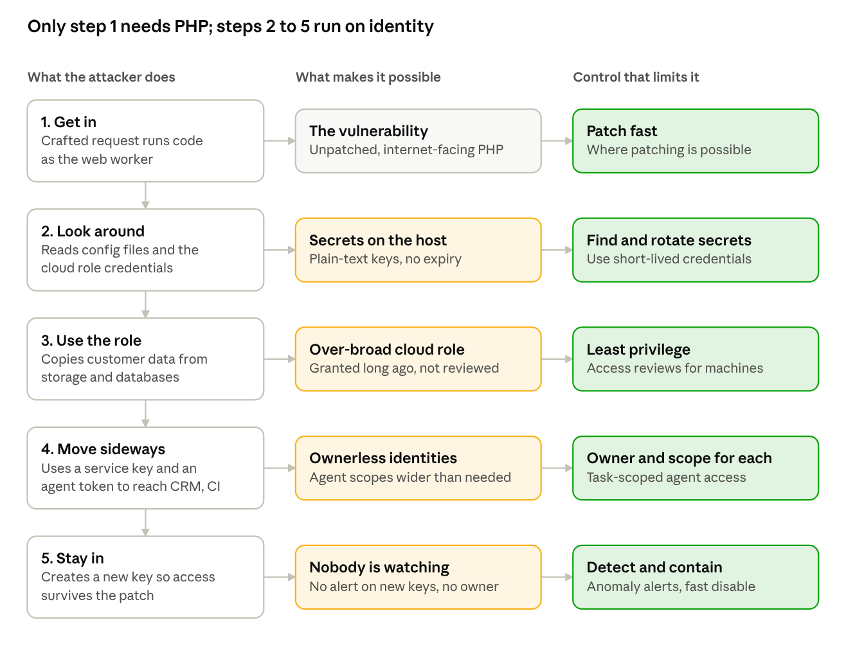
Figure 1: Attack path · 5 steps, each with its gap and control
Read each row left to right: the attacker's move, what makes it possible, and the control that would limit it.
Only step 1 depends on PHP. Everything after it depends on identity. The attacker needs no second vulnerability, because the credentials, roles and agent tokens on the host already open the door. If each identity is tightly scoped, owned, monitored and quick to disable, the same attacker lands on a server that can reach very little.
How SailPoint closes the gap
SailPoint Agentic Fabric is not a PHP scanner, and it does not replace patching. It covers the identity side of the response, helping limit how far a breach can spread.
SailPoint builds a unified identity graph that connects human users, entitlements, machines and agents, with human accountability, succession and governance of non-human identities across business applications. SailPoint Agentic Fabric adds depth on secrets and credentials: a lineage map of how credentials are actually used, plus real-time detection and response. SailPoint Identity Security is the governance foundation across human, machine and agentic identities.
| Question after patching | How SailPoint helps |
|---|---|
| Which identities were tied to the affected workloads? | One registry of service accounts, roles, credentials and agents, with Wiz, AWS and other 1000+ connectors. |
| What could they reach? | The Identity Graph traces access end to end, from user to agent to IAM role to S3 bucket. Lineage graph shows where credentials are used. |
| Who do we call? | Every machine identity gets an accountable owner, kept current as people move. |
| Can we shut it down, with a record? | Disable accounts and deactivate agents from one place, audit-logged. |
| Will the next one hurt less? | Access reviews cut standing privilege. |
Two more points matter for a web-tier vulnerability. Agents and credentials also live on developer endpoints, and SailPoint's endpoint discovery finds them there. And if a credential must be treated as burned, SailPoint Agentic Fabric detection and response watches token behavior and anomalies, which is where an attacker using a stolen credential would show up first.
Patching, network and runtime tools each see part of an incident. A governed identity for every machine and agent gives them a shared answer to "what could this host reach, and who owns it?"
