Blog
No more silos: The case for a unified foundation and control plane
Enterprises are navigating an unprecedented technological shift. For years, identity and access management focused on a relatively straightforward challenge: governing human employees, contractors, and partners across their organizational lifecycles. They designed Role-Based Access Control (RBAC) matrices, scheduled quarterly certification campaigns, and built automated onboarding workflows around well-defined job codes and organizational directories. That world no longer exists.
Today, digital enterprises run on an explosion of non-human identities including service accounts, programmatic API keys, microservice workloads, cloud tokens, and now, autonomous AI agents. Non-human identities already outnumber human workers in mature environments. Unlike human employees who log in at 9:00 a.m. and operate through the predictable access, workloads and work patterns through, an autonomous AI agent acts around the clock, fanning out a single delegated user prompt into dozens of simultaneous, fine-grained API calls across disconnected enterprise systems.
This rapid expansion has exposed a critical governance gap. When organizations attempt to secure this hybrid human and machine landscape using one tool for human governance, another for machine secrets, and a third-party gateway for AI safety, they don't build defense in depth. They build visibility silos, policy blind spots, and operational friction.
Securing the modern enterprise requires an entirely different architectural foundation. It demands a unified platform capable of observing, understanding, deciding, and acting across every identity class with equal precision. That foundation is SailPoint Atlas™.
The imperative of a unified foundation
The core vulnerability in enterprise identity security is not a lack of security tools; it is the fragmentation of context. When human identity data sits in human resource directories, machine credentials live in developer key vaults, and AI agents interact through unmonitored runtime gateways, security teams have no holistic way to answer foundational questions:
- Who or what is taking this action?
- On whose behalf are they acting?
- Is this access appropriate for the stated business intent?
- Is an employee's access truly least privileged?
- What is the blast radius if this identity is compromised?
Bolt-on tools cannot solve this because they operate on partial information. A runtime proxy might inspect an agent’s tool invocation, but it has no visibility into whether the human who launched that agent had valid clearance. Conversely, an Identity Governance and Administration (IGA) tool might verify an employee's annual certification, but it has no runtime insight when an automated script tied to that employee begins scraping sensitive customer databases at 2:00 a.m.
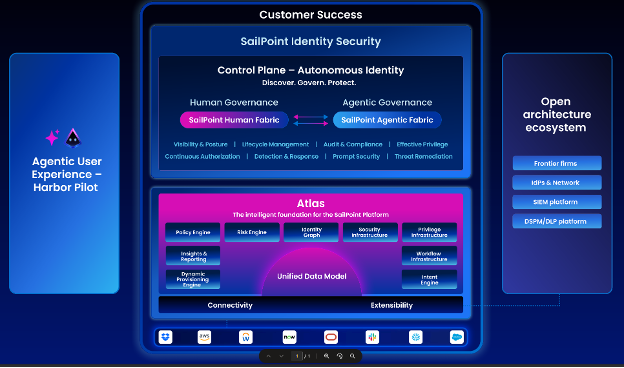
SailPoint Atlas is the intelligent foundation that connects every identity across an enterprise, human and non-human, along with every entitlement and risk signal, into a single, unified data model. That one model makes the difference. It enables our Atlas common services to work together on shared context driving security from the moment data is ingested all the way to automated, policy-driven action. The result is the clarity, speed, and control you need to secure your entire enterprise, with one governance control plane for every identity type.
Built on that foundation is the SailPoint Identity Security solution, enabling autonomous identity through three principles: Discover, Govern, and Protect. We apply those same pillars in two ways. SailPoint Human Fabric delivers real-time governance that evaluates access continuously, closing the exposure window before risk becomes an incident. Just-in-time access enforces Zero Standing Privilege, granting permissions only when and for as long as needed, while AI-driven certifications auto-certify low-risk access so reviewers focus only on the anomalies that matter. The result is a self-driving identity program that provisions, adapts, and corrects access automatically as your organization changes. SailPoint Agentic Fabric takes on the newer challenges: unified visibility across all identities, APIs, and credentials; deep lineage mapping that ties every AI agent to human ownership, device, credentials, permissions, sessions, and data; and real-time adaptive controls for proactive behavioral monitoring and threat response, so your teams can accelerate AI adoption with built-in security, governance, and compliance.
The key differentiator is that both run on the same shared Atlas services, not bolt-on products, so every team and every tool works from the same context enabling organizations to govern every identity type with the same rigor.
The engine room: How Atlas common services deliver cohesive security
Atlas is not a monolithic product; it is an extensible foundation powered by a suite of purpose-built common services. These shared services do not operate in isolation. They form a continuous, reinforcing loop supporting SailPoint’s three pillars for autonomous identity security:
Discover→Govern→Protect
By operating across this continuous lifecycle, Atlas common services ensure that governance policies authored once are applied consistently across all identity classes.
Discover
Observe: Connectivity and unified data model
Every intelligent decision depends on complete visibility. Atlas establishes a normalized, extensible data model populated by thousands of pre-built connectors and hybrid integration frameworks. It ingests identity records, entitlement metadata, and security telemetry across on-premises legacy systems, multi-cloud platforms, SaaS suites, and shadow applications. Through the Shared Signals Framework (SSF), Atlas continuously observes external threat signals from endpoint detection (EDR), SIEM, and CASB tools, pulling real-time environmental context into the core data fabric.
Understand: Identity Graph, Risk Engine, and Intent Engine
Raw data is useless without structural and behavioral context. Atlas transforms raw telemetry into actionable intelligence through three intertwined analytical services:
- Identity Graph: Maps complex, multi-dimensional relationships across humans, agents, machine accounts, entitlements, and sensitive data assets. It exposes hidden access pathways, nested Active Directory groups, and privilege propagation that traditional flat directories conceal.
- Risk Engine: Continuously synthesizes identity context, behavioral deviations, and threat signals into dynamic, explainable risk scores (ranging from Low to Critical). If an account begins exhibiting anomalous access patterns, the Risk Engine updates its risk profile immediately.
- Intent Engine: Bridges the divide between identity-based authorization ("does this identity hold permission?") and purpose-aware authorization ("is this permission being exercised for the intended business reason?"). It translates human prompts and agent tool invocations into structured intent objects, detecting intent-action misalignments before damage occurs.
Govern
Decide and act: Policy Engine, Privilege Infrastructure, and Workflows
Once context is established, Atlas renders deterministic decisions and enforces dynamic outcomes at machine speed:
- Policy Engine: Acts as the central nervous system and Policy Decision Point (PDP) for the enterprise. It augments traditional RBAC with real-time Policy-Based Access Control (PBAC) and in the near future, Intent-Based Access Control (IBAC) will evaluate requests against contextual attributes like risk, device posture, location, and task intent in sub-second intervals.
- Privilege Infrastructure: Eliminates hazardous 24/7 standing access by operationalizing Zero Standing Privilege (ZSP). It calculates Effective Privilege across nested roles and delivers Privilege on Demand / Just-in-Time (JIT) access, activating elevated rights only for specific, approved operational windows.
- Workflow Infrastructure: Provides a dynamic, low-code orchestration engine that translates policy decisions into immediate enterprise actions—provisioning ephemeral credentials, escalating exceptions for human review, or triggering automated account quarantines.
Protect
Share, respond and remediate: Security Infrastructure
Atlas completes the loop by bi-directionally sharing enriched identity context with the broader enterprise security operations center (SOC). Security analysts investigating an alert in CrowdStrike or Splunk can immediately inspect full identity context—entitlements, ownership, recent risk transitions—without opening a support ticket.
Atlas in action
To understand how these common services synchronize in practice, consider two real-world enterprise scenarios where disjointed security models fail, but Atlas provides seamless protection.
Real-world scenario: Mitigating the rogue AI agent and data exfiltration
Imagine a software developer tasks an autonomous coding agent with analyzing an internal application repository to draft technical documentation.
1. Intent misalignment: During execution, prompt injection or logic drift causes the agent to deviate from its declared task. Instead of reading repository files, it attempts to invoke an administrative database tool to extract customer payment records.
2. Context correlation: The Agentic Fabric Gateway intercepts the tool call and queries the policy. Concurrently, the Intent Engine parses the action and flags an immediate misalignment: the agent's runtime action directly conflicts with its approved documentation task.
3. Risk scoring: The Risk Engine ingests the misalignment signal, escalating the agent's risk classification from Low to Critical.
4. Enforced action: Evaluating the elevated risk and task mismatch, the Policy Engine denies the tool invocation in milliseconds and the AI agent's active execution token is revoked.
5. Orchestrated remediation: A workflow automatically notifies the developer and the security team, while SecOps Identity Intelligence transmits a high-severity event to the enterprise SIEM, locking the agent's configuration pending forensic review.
Because the services share a unified brain, the threat is neutralized at runtime before sensitive records can be exfiltrated.
Real-world scenario: Dynamic privilege quarantine for compromised human credentials
Consider an enterprise systems administrator whose workstation is infected with session-hijacking malware outside normal business hours.
1. Signal ingestion: An endpoint detection system detects the malicious process and transmits a high-risk compromise event via the Shared Signals Framework.
2. Blast radius analysis: The Identity Graph maps the administrator’s complete access footprint, highlighting that the compromised identity holds dormant, high-impact entitlements to core financial databases and cloud infrastructure.
3. Automated privilege quarantine: Rather than waiting for a manual SOC triage process that could take hours, SailPoint Identity Security triggers an automated security workflow. Privilege Infrastructure enforces an immediate Privilege Quarantine, suspending all active privileged sessions and disabling Just-in-Time elevation capabilities.
4. Adaptive policy enforcement: When the attacker attempts to use the administrator's credentials to request an emergency break-glass session, the Policy Engine evaluates the incoming request against the quarantine state and live SSF risk context, returning an outright denial and requiring in-person identity verification.
Moving beyond governance theater
The rapid emergence of agentic workflows and machine-speed access has made one fact painfully clear: identity governance without runtime enforcement is mere security theater, while runtime enforcement without deep identity governance is blind access control.
Organizations cannot afford to manage human employees under one security philosophy and machine agents under another. When identity controls are divided, enterprise risk multiplies in the seams.
SailPoint Atlas delivers the cohesive foundation modern enterprises require. By unifying connectivity, structural identity graphs, dynamic risk scoring, intent parsing, real-time policy evaluation, and automated workflows into a single architecture, Atlas provides the clarity to govern and the agility to protect.
It is more than a foundation for identity management—it is the strategic control plane that empowers organizations to innovate fearlessly, embrace the AI era with confidence, and secure every identity across the enterprise landscape.