Blog
Identity’s new brain: Powering the enterprise with a centralized Policy Engine


Imagine a massive, rapidly expanding city where every single neighborhood has its own unique traffic laws, its own custom-built toll booths, and its own separate driving tests. It's chaotic, unpredictable, and a nightmare to govern.
For a long time, enterprise access has looked exactly like this.
Organizations have historically embedded authorization logic across disparate Identity Governance and Administration (IGA) workflows, custom applications, scripts, and point solutions. Every time a new SaaS app comes online or a new business initiative emerges, engineering and security teams are forced to rebuild security logic from scratch. The result? Severe role explosion and operational gridlock.
Over 70% of enterprises still rely heavily on Role-Based Access Control (RBAC) models loaded with standing privileges. Yet industry breach analyses consistently show that more than 80% of security incidents involve excessive or persistent privileges that remained in place after a change in user context, business need, or risk conditions.
That fragmented approach was painful enough when we were primarily managing human employees. But today, the landscape is shifting under our feet. We are plunging headfirst into an agentic world. Machine-speed access, service accounts, and autonomous AI agents are executing complex tasks and querying sensitive enterprise data at a scale that shatters traditional security models. Agentic security introduces entirely new patterns of access delegation, intent scoping, and ephemeral, temporal access.
If every team in your organization chooses a disconnected enforcement and policy approach to handle this new AI-driven reality, you aren't just creating an operational bottleneck, you're building a fragmented security architecture with massive blind spots. It's time to stop treating authorization as a localized afterthought and elevate identity security into holistic cybersecurity.
Enter the Policy Engine common services of the SailPoint AtlasTM. Think of it as a citywide traffic governance platform that replaces disconnected local rules with one consistent way to determine who can drive, where they can go, and under what conditions with real-time context. Instead of scattering access logic to the wind, the Policy Engine serves as the single decision layer for all access. Whether an access request comes from a new hire in accounting, an engineer requiring temporary elevation, or an autonomous agent querying a core database, it is evaluated in one place—delivering real-time, context aware sub-second, consistent policy decisions and complete auditability.
A Modern Hybrid: Augmenting RBAC with PBAC and intent
Crucially, moving to Policy-Based Access Control (PBAC) does not mean tearing out your existing investments. RBAC remains foundational for enterprise role modeling. The SailPoint Policy Engine implements an intelligent hybrid model: RBAC roles, entitlements, and metadata serve as rich baseline inputs that are dynamically evaluated alongside real-time contextual signals (risk scores, device posture, location, threat signals) and task intent.
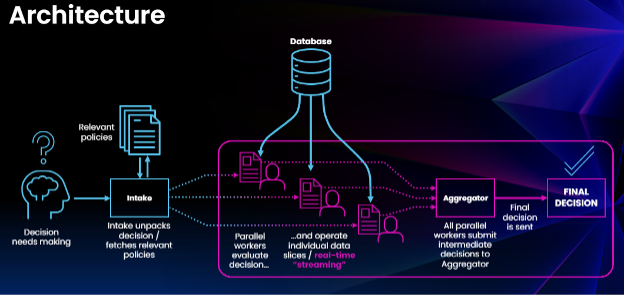
By establishing this shared service, identity and security teams can reuse a proven policy evaluation, logging, and governance layer. While open-source tools like Open Policy Agent (OPA) offer a baseline, enterprise identity security requires a complete decision plane. The architecture relies on the Policy Decision Point (PDP) as the control layer, delivering sub-second decisions by communicating directly with the Policy Administration Point (PAP) for version-controlled policies and the Policy Information Point (PIP) for pre-indexed context.
The expert view: What context-aware access really looks like
We sat down with Thomas Burt, SailPoint’s Lead Product Manager behind the Policy Engine, to walk through how these concepts transform everyday security and access scenarios.
Starting with a familiar system: CRM customer reports
Q: Give us a concrete example. Where does context-aware access actually change the outcome?
Thomas Burt: A great example is CRM customer reports. In most enterprises, access has traditionally been binary: you were put into a sales or accounting role during onboarding, and that role determined whether the door was open or closed. The problem is that decision may have been made months earlier, with no awareness of what’s happening right now. If a laptop is compromised, credentials are leaked, or a risk profile changes due to unusual behavior that static entitlement becomes an open door.
Context-aware access changes that. Instead of relying on a static entitlement, the Policy Engine evaluates the request in real time using signals like who the user is, how sensitive the report is, whether the device is compliant, what time the request is happening, where it’s coming from, whether the user is on VPN, and whether security systems are flagging unusual behavior.
That’s what changes the outcome. Under normal conditions, access might be approved instantly for a full workday. If the same request comes in after hours or with elevated risk, it might be limited to a 1-hour window. If multiple risks show up, it can require manager approval or step-up authentication. And if threat signals suggest spoofing or compromised credentials, access is denied automatically and security is alerted. So instead of a static keycard that works forever, you get a doorway that evaluates the situation in real time and responds accordingly.
Feeding the engine: Contextual data source integration
Q: That kind of decision only works if the engine has the right information. How do you get all that context in without grinding systems to a halt?
Thomas Burt: That’s the part people underestimate. To maintain sub-second decision latency where requests are evaluated in under 100 milliseconds, we implement intelligent data caching with aggressive Time-To-Live (TTL) strategies targeting cache hit rates above 80%. When an access request arrives, the Policy Decision Point (PDP) doesn't need to make half a dozen slow external API hops; the correlated context is already indexed and ready to evaluate. We consolidate this data into our data model, but we also support getting external data using API calls. Keep in mind, any external data calls come at a temporal cost.
Keeping the plumbing healthy: PIP health monitoring
Q: If policies depend on external signals, what happens when one of those sources goes down or gets slow?
Thomas Burt: That’s why we treat the PIP as a first-class citizen. If the engine can’t get the context it needs, or can't get it within strict SLAs, decisions suffer.
We give policy administrators direct visibility into PIP health, latency metrics, and connection status via dedicated operational dashboards. If a third-party threat feed starts degrading or an API fails, the admin receives proactive alerts before it affects production traffic.
Furthermore, policies can be configured with explicit fail-open or fail-closed semantics depending on the criticality of the target resource. For low-risk internal collaboration tools, you might default to standard RBAC rules if context is degraded; for your core financial database or production AWS accounts, the engine fails closed and routes to manual verification. You don't wait for a security incident to discover that a sensor went dark.
Testing before deploying: Impact simulation and blast radius analysis
Q: In complex environments, security teams are often terrified that changing a policy will accidentally lock out half the company. How do you prevent that?
Thomas Burt: That fear is completely justified when policies are hardcoded or written in opaque scripts. That’s why the SailPoint Policy Engine includes two dedicated ways to simulate policy outcomes. First, within the policy creation process flow to simulate and validate the policy you are creating generates the intended outcomes. Second, a standalone simulation tool that allows for bulk simulation across all policies of a given policy type. This ensures you can test and validate the proper outcomes when multiple policies match. Further, you can create repeatable scenarios to periodically test across all policies to ensure the outcomes you intend.
Right-sizing oversight: Audited approvals by risk classification
Q: Not every policy change carries the same enterprise risk. Does the engine treat them identically?
Thomas Burt: No, and that’s intentional. Applying heavy committee approvals to every minor tweak trains people to circumvent governance or rubber-stamp changes. The Policy Engine routes policy creation and lifecycle updates through an adaptive approval process via SaaS workflows that scales with the risk classification of the policy so that:
- Low-risk policies require a single review or standard admin check.
- Medium-risk policies route through multi-step review (e.g., policy author and application owner).
- High-risk policies mandate quorum-based approvals, where multiple designated security stakeholders must cryptographically sign off before the policy is promoted from staging to active production.
Every transition from draft, to in-review, to active, to retired is recorded in an immutable audit trail.
Eliminating standing privilege: Just-in-Time (JIT) access and SSO integration
Q: What role does the Policy Engine play in Zero Standing Privilege (ZSP)?
Thomas Burt: Zero Standing Privilege is the gold standard of Zero Trust, but you can’t achieve it if privileges are permanently assigned in directory groups.
The Policy Engine acts as the dynamic decision authority for Just-in-Time (JIT) access. Instead of granting an administrator persistent 24/7 root access to production servers, access remains dormant. When the admin needs to perform maintenance, an in-the-flow request is evaluated against real-time risk, change ticket status, and current posture.
The Policy Engine renders a time-bound decision with an enforced sunset date (for example, 1 to 4 hours). Once the decision is rendered, automated provisioning activates the access and the moment the window closes, or the task completes, automated revocation de-provisions the credentials in under 60 seconds. Looking ahead, by intercepting authentication flows at the SSO/IdP layer (via OIDC and SAML claims enrichment), we can inject ephemeral, context-backed entitlements directly into runtime tokens without leaving standing permissions behind.
The new frontier: Autonomous AI agents and Intent-Based Access Control (IBAC)
Q: We mentioned AI agents earlier. How does authorization work when the requestor isn't human?
Thomas Burt: This is one of the most exciting capabilities we’re building. Non-human identities (service accounts, APIs, bots) already outnumber human identities in most enterprises and autonomous AI agents are accelerating that ratio exponentially.
Traditional RBAC fails completely here because an AI agent’s access needs fluctuate based on the specific task it is assigned. If an agent needs to resolve a customer billing inquiry, it shouldn't have permanent read-write access to the entire billing database.
We are expanding the Policy Engine to support Intent-Based Access Control (IBAC). Working through an Agent Gateway or runtime model context protocol (MCP), the agent passes its intended task outcome alongside its request. The Policy Engine evaluates the agent's identity, ownership context, and stated intent against enterprise constraints. It then grants scoped, least-privilege access valid only for the exact duration required to complete that task, without requiring human-in-the-loop approval for routine operations. If the agent attempts an action outside its declared intent, the request is immediately blocked.
When conditions shift: Dynamic access downgrade and continuous evaluation
Q: Access used to be decided once at login. What happens after someone has access and their situation changes mid-session?
Thomas Burt: Static approval states are a dangerous illusion because risk doesn’t stay still. An employee logs in from an office laptop at 9 a.m., but at 11 a.m. their device endpoint agent disables, or their session token is flagged for suspicious export.
Because the Policy Engine continuously subscribes to event triggers from SIEM, EDR, and SSF/CAEP feeds, it doesn't wait for a scheduled nightly review. Over 90% of high-risk context events trigger continuous re-evaluation in less than one minute.
When risk factors rise, the Policy Engine issues an updated decision to the consuming Policy Enforcement Point (PEP) to dynamically downgrade access in real time. Instead of an all-or-nothing binary lock, privileges are pruned: high-privilege administrative rights or export capabilities are stripped, reducing the session to basic read-only status until verification occurs.
When risk spikes: Automated termination and account quarantine
Q: And when the signal indicates an active, severe threat?
Thomas Burt: We eliminate the human latency gap. When the Policy Enforcement Point detects a critical event, it initiates a re-evaluation of all policies resulting in a decision that is relevant based on the changed conditions, such as terminating active sessions, revoking access, quarantine, and more.
Downstream enforcement points revoke tokens, terminate connections, and trigger automated security response workflows to lock the identity across directories. In traditional environments, the delay between a SOC alert and manual account suspension can take hours. By automating mitigation at machine speed, that breach window collapses to near zero.
Empowering the modern enterprise: speed, security, and governance
A modern Policy Engine thrives on context. Our approach leverages rich identity data, external system insights, and continuous Shared Signals Framework/CAEP-style signals to make dynamic, context-aware evaluations. This means making sub-second decisions that reflect live conditions and actual risk, rather than relying on stale, static approval states. Ironically, centralizing and standardizing this security layer is ultimately a speed story. One reusable policy engine, architected to scale and perform today and into the future, and a unified set of APIs reduce duplicated authorization work, allowing product teams to build faster and creating an accelerated path to market for new innovations.
Ultimately, this unified foundation empowers organizations to modernize safely and at unprecedented speed. By acting as the common authorization foundation, the SailPoint Policy Engine significantly reduces enterprise risk by eliminating fragmented logic, closing control gaps, and ensuring that policy changes are authored once and applied everywhere. Customers experience a drastically shortened time to market for advanced capabilities, enabling access models like just-in-time provisioning, continuous SoD, and agent-driven workflows to be introduced and iterated rapidly without the burden of re-engineering downstream systems. The result is a highly secure, agile enterprise that maintains sub-second decisioning at scale, preserving strategic flexibility as future AI and security demands continue to evolve.
What’s next?
The move from fragmented, neighborhood-by-neighborhood rules to a single, intelligent control plane isn't just an architectural cleanup, it is the prerequisite for governing enterprise access in a Zero Trust, agentic world.
It provides one place to decide to enforce and prove compliance.
That is what empowers organizations to embrace AI-driven innovation with total confidence. If you're wrestling with authorization logic scattered across your applications, start by mapping where those decisions live today and identifying the real-time context your systems are currently blind to.
Ready to see how the SailPoint can transform your enterprise authorization? Register for a demo.
