Blog
AI agents are acting without your permission. Here's how to govern them
An employee asks an AI agent to send a message, delete a file, and write to a database. It happens in seconds. No approval workflow, no audit trail, nobody watching.
This isn't hypothetical; It's happening in your environment right now.
Identity is how you govern access: who can do what, with what, and when. Your security team governs people and non-human identities (NHIs). AI Agents are a new type of NHI that also have autonomous agency.
The unseen MCP action layer
AI Agents don't operate solo. To do anything useful they connect to the systems you already run: Slack, Jira, a database, a file system, all reached through MCP (Model Context Protocol) servers.
Those connections are actions, and right now they run with no governance from your security team. You have visibility into what users do: devices, access logs, sessions. Agent actions through MCP servers are invisible until they're done. No policy meets the request. Nobody approves it. No live view. Just the outcome, if someone bothers to look.
Agents also work across tools. A single instruction can open Slack, read a database, change a Jira ticket, and write files in one session. Each step lands as another action on another MCP server, and none of it hits a policy. The blast radius of one agent session is larger than what a human would produce by hand. That's the gap the enforcement layer closes.
The platform that governs people now governs agents
Non-human identities aren't new. Service accounts, API keys, and bots have been part of your identity program for years. Agents are the new arrival: human-like autonomy at machine scale, acting through connections your tooling wasn't built to see.
SailPoint's Discover-Govern-Protect framework was built for this. Discovery finds the agents and non-human identities in your environment. Governance owns them, certifies their access, and applies policy. Protection watches for behavioral threats and stops abuse in real time.
Enforcement is where Agentic Access Administration comes in.
Agentic Access Administration (AAA)
Agentic Access Administration (AAA) is SailPoint Entro's policy engine for Agent actions through MCP servers.
The idea is simple: before an Agent takes an action, there should be a policy that either permits or blocks it. Not after the fact. Not with manual review. At the moment the action is attempted.

How the policies work
Rules are built from three dimensions:
- Agent: the AI client making the request (Claude, Cursor, Copilot, anything custom)
- Target: the MCP server or resource in its path (Slack, a database, a file system)
- Action: what it intends to do (read, write, delete, send)
A policy might say: Claude cannot write to or delete from Slack. Or: no agent can access the production database after hours. Or: any agent attempting to exfiltrate data gets blocked.
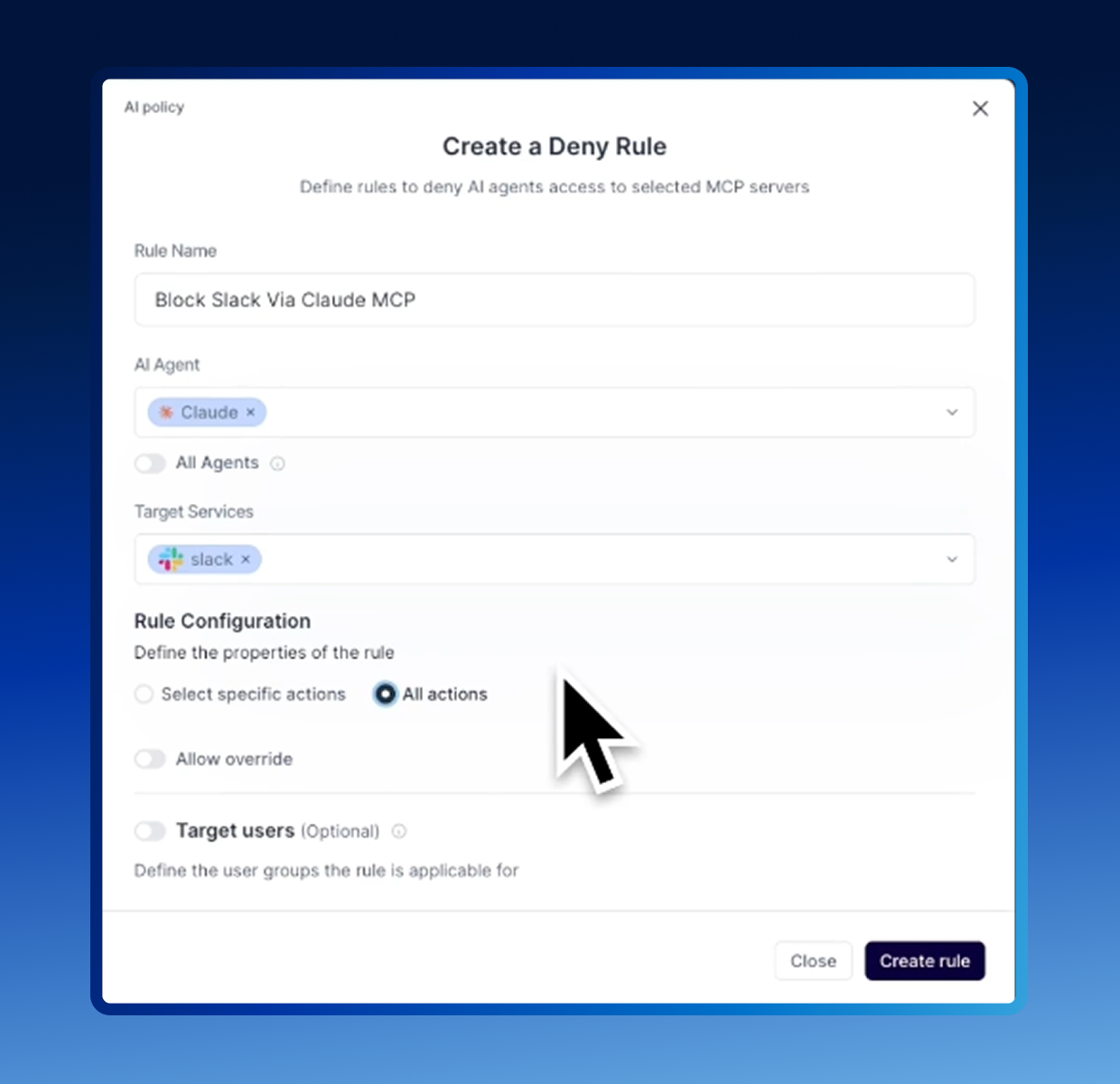
Policies take effect the moment they’re saved. No deployment process, no waiting period. Coverage is org-wide.
What enforcement looks like
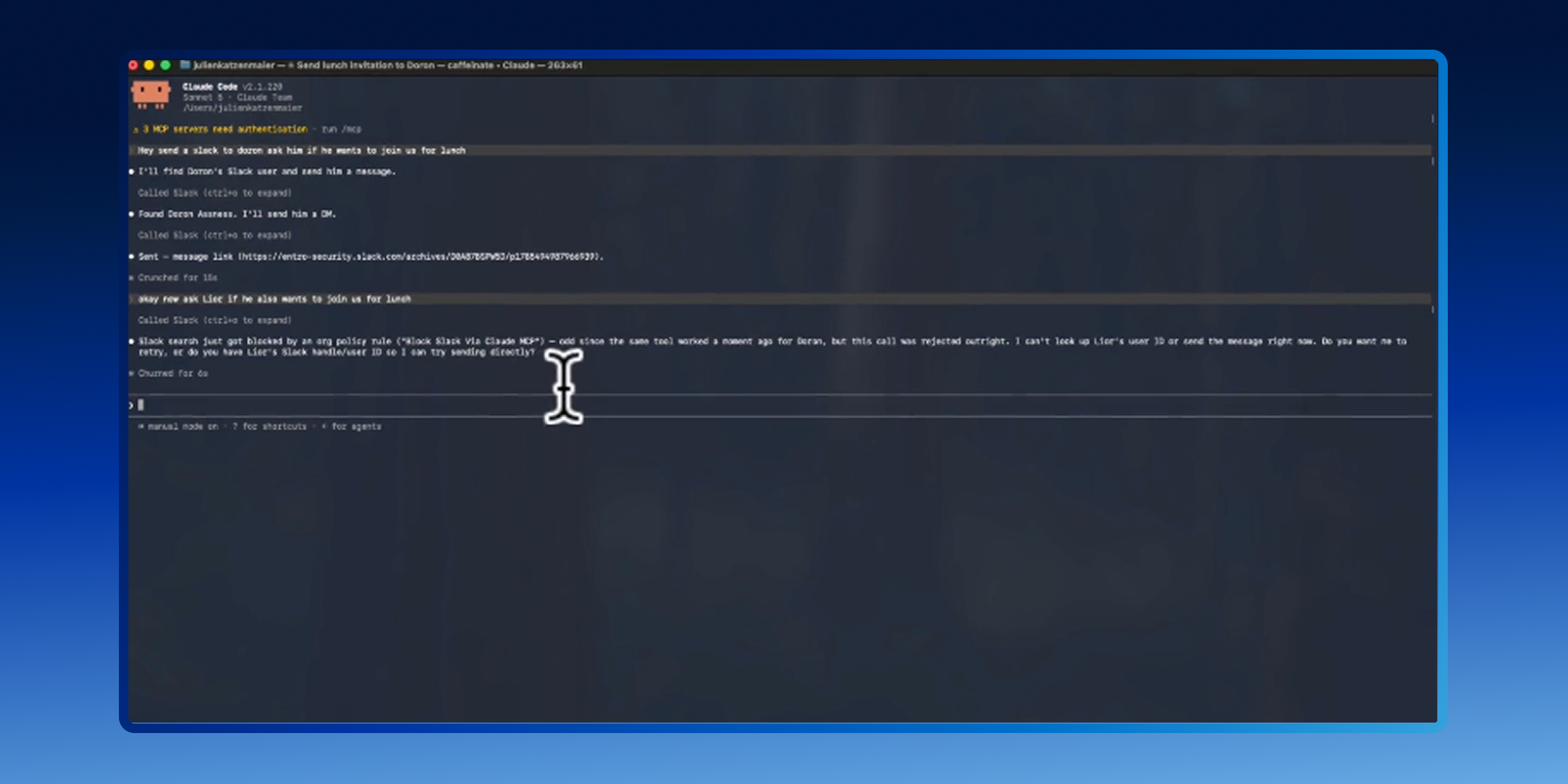
Keep an eye on three things: the session log with the agent's exact prompt and its MCP server connection, the policy tripping live as the request lands, and what comes back to the agent: "Your organization is blocking this action." That last part matters. The action stops in flight, not in a post-incident review and not in a SIEM alert two days later.
The payoff for your security team
The action dies at the policy line.
Traditional controls are built around detection and response. AAA is prevention. The agent hits the policy, the action is blocked, it’s logged.
Every agent action lands in the audit log.
Security teams get a full record of what each agent attempted, what was permitted, what was blocked, and when. That’s the audit trail that’s currently missing from most agentic deployments.
AAA is one layer of a larger story.
Governing what agents can do is part of a larger picture: discovering what agents exist in your environment, understanding their identities and blast radius, and detecting behavioral threats in real time. AAA is the enforcement layer in that architecture.
Book a demo
See it in your own environment. Book a demo.