Blog
Agent Audit: Exportable evidence for agents you already govern
It is 4:00 PM on a Thursday when internal audit asks for immediate proof on every AI agent operating across your enterprise—what agents exist, who owns them, what systems they can touch, and what controls were enforced before they reached production. For most security and compliance teams, that single request kicks off an exhausting scramble: chasing engineers across Slack, stitching together outdated spreadsheets, and taking screenshots across disconnected consoles.
The AI governance gap
Recent SailPoint research reveals that 82% of organizations already run AI agents in production. These agents and related non-human identities (NHIs) rarely go through standard procurement. They spin up inside cloud workloads, developer tools, browser extensions, and Model Context Protocol (MCP) clients. They hold elevated credentials and act directly on organizations' data.
Traditional governance, risk, and compliance (GRC) tools struggle here because they do not sit natively on your identity infrastructure. They know a policy exists on paper, but they cannot verify whether an autonomous agent honored that policy at runtime.
When runtime actions cannot be verified against identity controls, compliance turns into guesswork which can lead to gaps and within the current agentic are not acceptable.
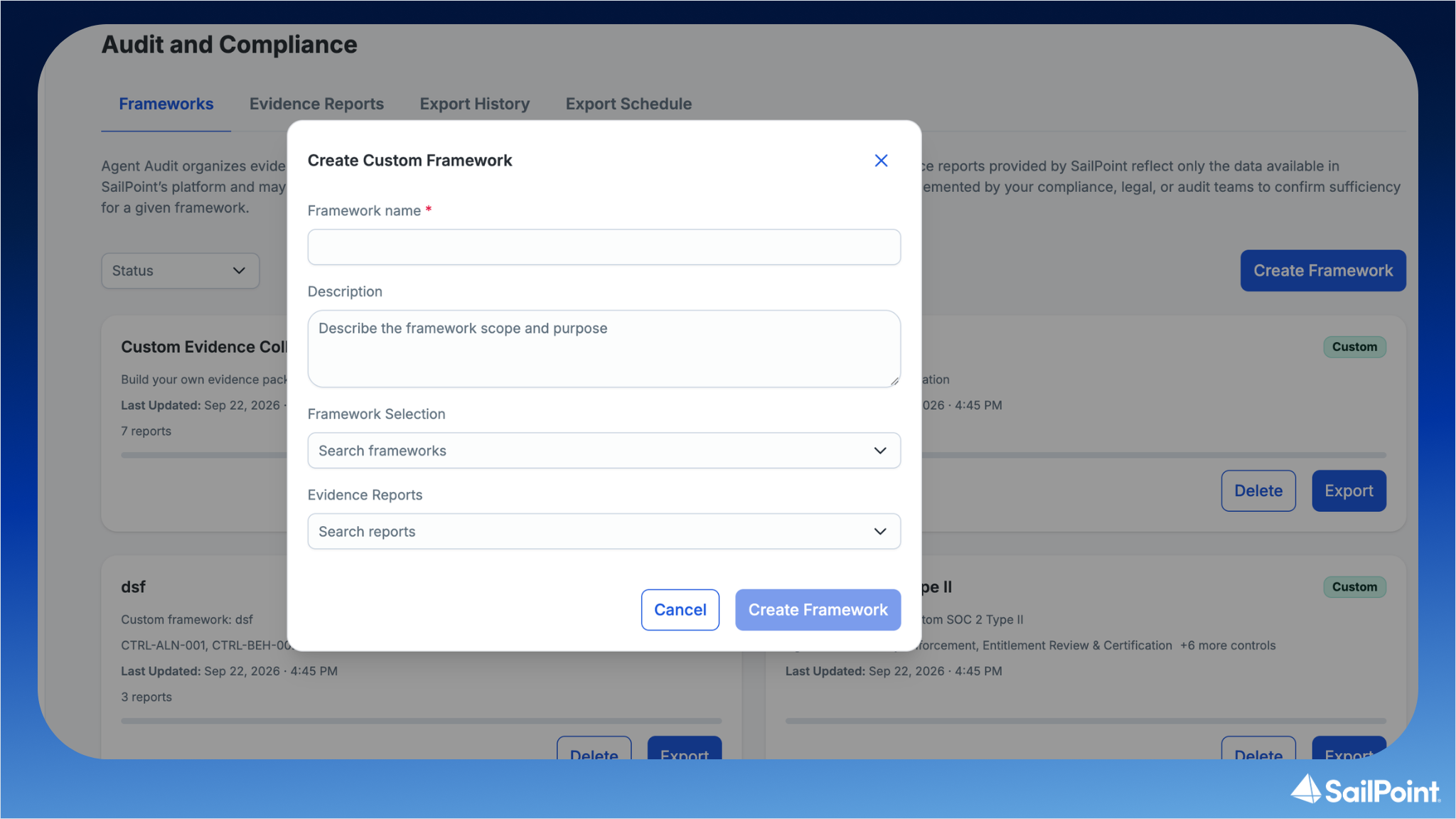
Agent Audit: Identity data turned into audit proof
Agent Audit, a feature within the SailPoint Agentic Fabric, solves this problem.
While the broader SailPoint Agentic Fabric discovers agents, enforces runtime controls, and stops unauthorized actions, Agent Audit organizes the proof. It links your live inventory of agents and NHIs directly to historical governance decisions, turning continuous identity data into structured, framework-aligned evidence packages ready for you to export.
Tailored governance with custom frameworks
Off-the-shelf audit checklists rarely reflect how organizations actually deploy AI. Every company has unique risk tolerances, internal policies, and obligations under emerging standards like the NIST AI RMF, ISO 42001, or the EU AI Act.
That is why Agent Audit is built around custom frameworks.
Instead of boxing your compliance team into rigid, pre-canned templates, Agent Audit lets you build frameworks tailored to your internal security policies. You choose the controls, map the relevant evidence reports, and track readiness in real time—monitoring status across not started, partial, and complete.
Auditors get clean evidence organized around your company's rules, without anyone spending days reformatting data after export.
Core capabilities in Agent Audit
Agent Audit turns audit prep into an organized, repeatable workflow:
1. Framework customization and tracking
Build audit frameworks mapped directly to your internal policies and track implementation progress in real time.
2. Targeted evidence reports
Export verified data across eight distinct reporting categories:
- Agent identity inventory: Authorized agents and their assigned human owners.
- Application identities: Enterprise applications connected to agents.
- Machine accounts: Non-human accounts utilized by autonomous workflows.
- Credentials: Associated API keys, OAuth tokens, and secrets posture.
- Endpoints: Target machines, cloud instances, and environments accessed.
- MCP clients: Client interfaces initiating agentic requests via the Model Context Protocol.
- Tools: Specific functions and actions provisioned to agents.
- Governance action log: Tamper-evident trail of access requests, approvals, and revocations.
Every report supports category filtering and in-console previewing before export.
3. Export history
Review every generated package across statuses (available, in progress, or failed) and re-download historical evidence to show auditors consistent compliance over time.
4. Scheduled delivery
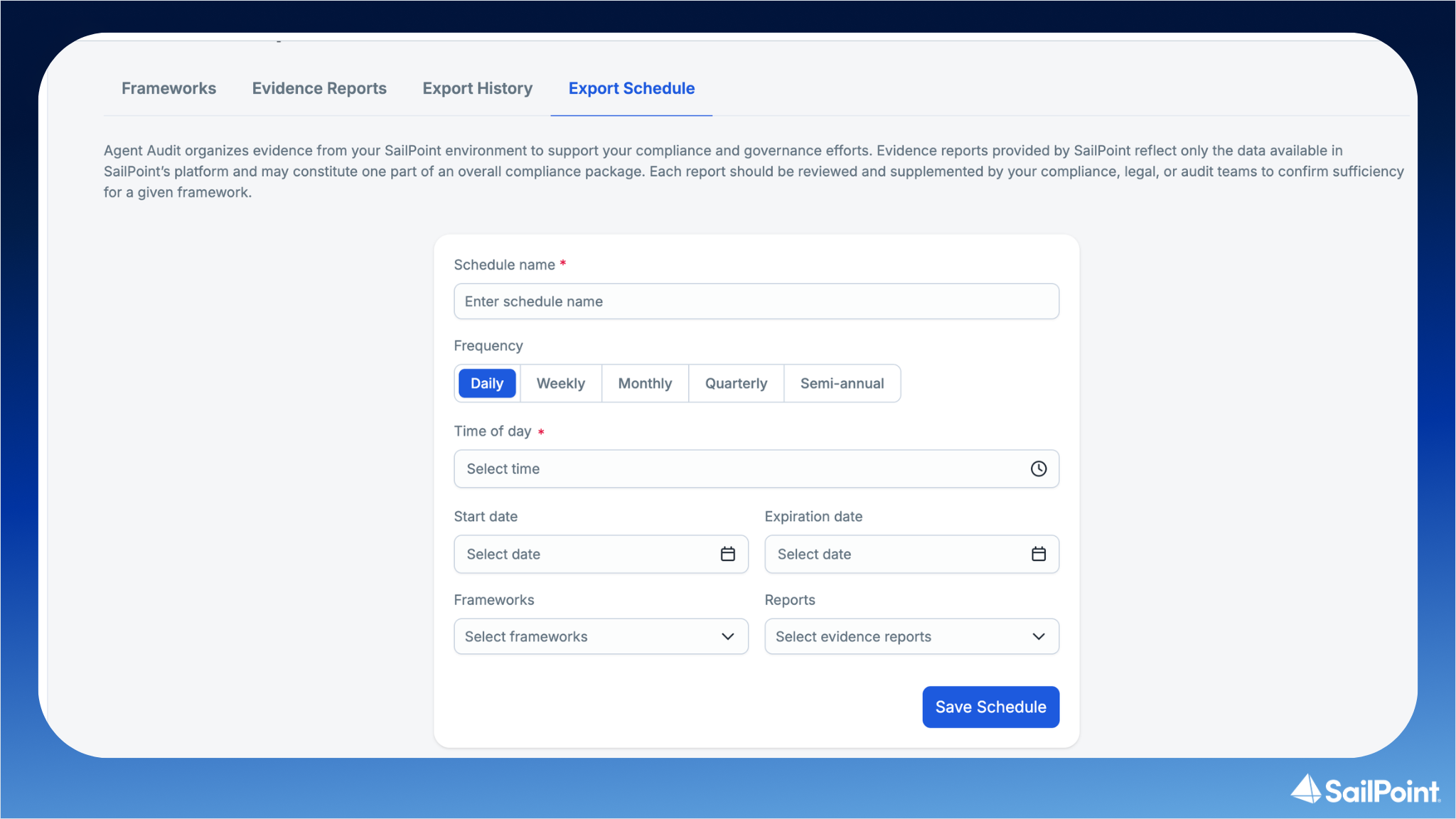
Run ad-hoc exports for unexpected audit requests, or schedule automated recurring deliveries on daily, weekly, monthly, quarterly, or semi-annual cadences.
What comes next: Unifying human and machine audit
Solving the audit problem for autonomous agents is only the beginning.
AI agents do not work in isolation. They act on behalf of human employees, trigger workflows across business systems, and inherit sensitive privileges. Security and audit boundaries cannot stay split between human users and autonomous machines.
The framework model in Agent Audit lays out the groundwork for how SailPoint is bringing all identity governance together. In time, compliance teams will evaluate human employees, service accounts, and autonomous agents through a single, connected identity system.
Audit preparation should be a natural output of solid identity security, not a weeks-long investigative chore. Agent Audit gives your teams verified; platform-backed evidence the moment risk teams and auditors ask for it.
Read the full data sheet here.
Schedule a demo to see Agent Audit and the SailPoint Agentic Fabric in action.