Lifecycle management
Automate the management and control of your complex identity security challenges and reduce risk to your business, brand, and bottom line with lifecycle management.
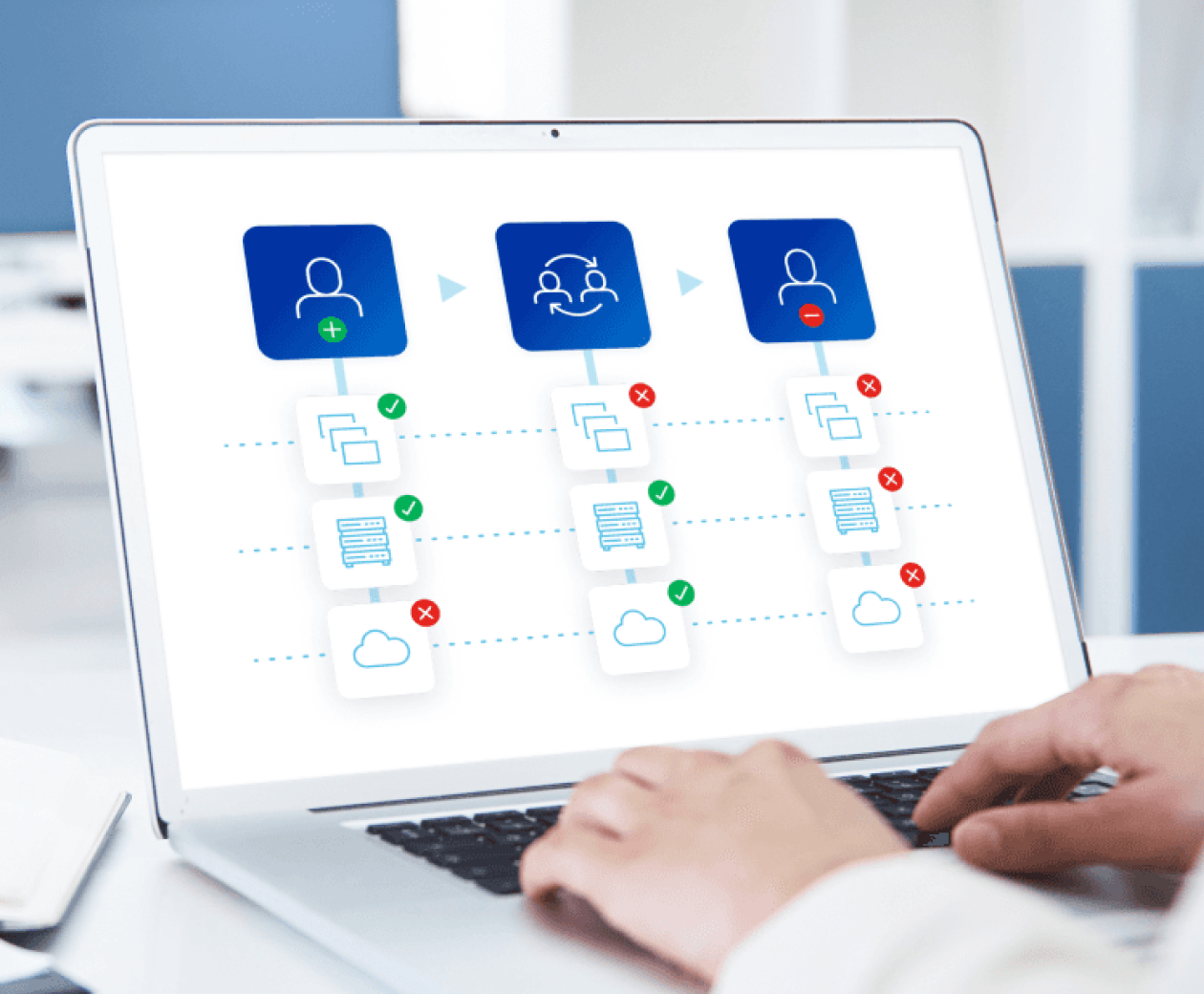
Challenge & solution
Optimize and secure access
Manually managing identity lifecycles creates security gaps and slows productivity. Users need fast, appropriate access, but errors and delays in adjusting permissions as roles change expose the business to risk.
An AI-powered, automated approach
- Improve IT productivity and efficiency.
- Strengthen your compliance posture.
- Accelerate time-to-value for digital initiatives.
- Secure access for your hybrid workforce.
Benefits
Intelligent, automated and secure identity management
Manage all your identities and evolving access privileges with AI-powered insights and processes. Eliminate over-provisioning and safeguard your organization from serious security threats by automating the complete identity lifecycle.
Mitigate internal threats
Leverage AI-driven, activity-based insights to enforce the principle of least privilege at scale. The system provides intelligent recommendations on appropriate access, empowering decision-makers to approve or revoke entitlements with confidence and reduce over-provisioning.
Related resources
Explore more on lifecycle management
Solution brief
AI-powered lifecycle management for applications
Learn more about how SailPoint’s application onboarding capability for SailPoint Human Fabric can help your organization discover, connect, configure and secure access to key enterprise applications and realize faster time-to-value.
faq
Frequently Asked Questions
What is identity lifecycle management, and why does it matter?
Identity lifecycle management (LCM) is the process of controlling the full lifecycle of all digital identities—from onboarding and provisioning to deactivating accounts upon departure. It is critical for ensuring every identity, whether human or machine, has only the right access for the right duration, which supports compliance and reduces risk. Beyond access rights, LCM streamlines identity-related processes, reducing manual intervention, and improving operational efficiency across hybrid IT environments. By automating repetitive and complex tasks, IT teams can minimize errors and accelerate onboarding while responding promptly to changes in user roles. This efficiency is essential for managing today’s diverse identity landscape, which includes not only employees and contractors but also non-human identities such as bots, service accounts, and AI agents.
How does identity lifecycle management strengthen security?
LCM strengthens security by governing access based on real-time role, context, and behavior. It automates provisioning, access adjustments, and deactivation, eliminating vulnerabilities like access creep and privilege misuse. This process applies to all identity types, including human users, AI agents, and bots, to enforce zero-trust principles.
By automating critical tasks such as provisioning, access adjustments, and deactivation, LCM eliminates vulnerabilities like access creep, privilege misuse, and orphaned accounts—significantly reducing the risk of insider threats and accidental exposures. Real-time governance ensures that access rights are continuously aligned with current roles and business contexts, enabling organizations to enforce least-privileged access and comply with regulatory requirements. Additionally, by reducing the reliance on manual processes, LCM minimizes the risk of human error and accelerates response to organizational changes or security incidents, supporting a proactive, zero-trust security model across complex, hybrid environments.
Can identity lifecycle management adapt to contractors, partners, machine identities, and AI agents?
Yes. Modern LCM platforms are built to govern a diverse identity landscape. For non-employee identities, LCM assigns profiles, enforces time-based policies, and tracks entitlements within a central framework, ensuring that no identity is overlooked or over-provisioned. This enables organizations to scale securely and reduce their attack surface. Machine identities (such as bots, APIs, and service accounts) and AI agents are assigned distinct identity profiles and subject to automated activity monitoring to ensure permissions are limited to their intended functions. LCM centralizes entitlement tracking and regularly audits access levels, enabling rapid response when an identity’s role changes or when anomalous behavior is detected. By leveraging automation, organizations can enforce least-privilege access, apply ongoing risk assessments, and ensure continuous compliance—regardless of identity type.
How can an organization implement effective identity lifecycle management?
To implement effective LCM, an organization should follow these best practices:
- Integrate with a Source of Truth: Connect the LCM system to an authoritative source, such as an HR system (like Workday or SAP SuccessFactors), to automatically trigger provisioning and deprovisioning actions based on employment status.
- Implement Role-Based Access Control (RBAC): Define roles with pre-approved sets of permission. This simplifies access assignments and ensures users only get the access they need for their job function.
- Automate Workflows: Automate the entire process, from user creation and modification to termination. This minimizes human error and ensures policies are enforced consistently.
- Establish Clear Policies: Define and document clear policies for access requests, approvals, and periodic reviews.
- Conduct Regular Access Reviews: Periodically review and certify user access rights to ensure they remain appropriate and to identify and remove any unnecessary permissions.
- Plan for Exceptions: Develop a process for managing exceptions, such as temporary access for contractors or special permissions for specific projects.
What are the typical outcomes of an effective identity lifecycle approach?
SailPoint Identity Security Cloud delivers LCM through policy-driven automation, AI-powered recommendations, and deep integration with business applications. This ensures that:
- Access is always right-sized — users get exactly what they need to do their jobs, no more, no less.
- Changes happen instantly — promotions, department moves, or project assignments trigger automated access updates.
- Risk is reduced — over-privileged accounts and dormant access are identified and remediated.
- Compliance stays intact — centralized controls and audit-ready reporting streamline oversight.
Ultimately, SailPoint’s LCM approach frees IT teams from manual access administration, reduces security exposure, and ensures every identity is governed consistently throughout its lifecycle.
Ready to take the next step?
Put adaptive identity to work
See how SailPoint sets the standard for identity security—helping enterprises reduce risk, scale with confidence, and stay ahead of what’s next.