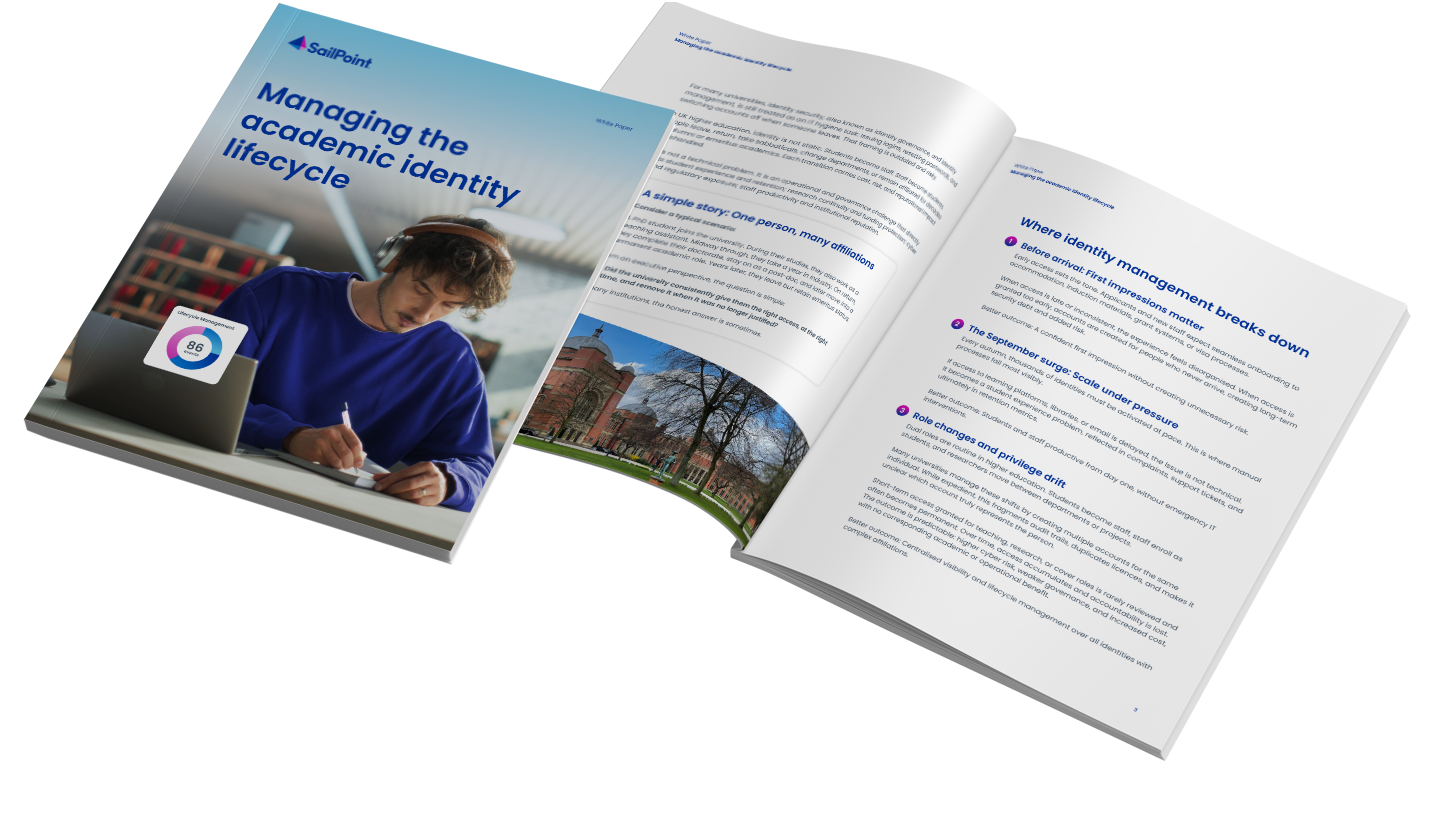
Managing the academic identity lifecycle
Why lifecycle-driven identity management underpins security, experience, and governance in higher education
Universities do not manage static identities. They manage people whose roles and affiliations evolve over time, often overlapping and changing across many years.
Students may hold multiple responsibilities. Staff may pursue further study alongside their professional roles. Researchers move between projects and institutions. Others leave, return, or retain limited affiliation as alumni or emeritus staff. In practice, a single individual often holds more than one role at the same time, each with different access needs. Every transition creates a point where access should change. When it does not, risk builds quietly.
Most identity challenges in higher education are not caused by sophisticated attacks or failed technology. They arise from manual processes and fragmented approaches that cannot keep pace with how universities actually operate.
This whitepaper explores where identity management breaks down across the academic lifecycle and the impact this has on security, governance, and institutional confidence.
Inside this whitepaper, you’ll explore:
- Why lifecycle transitions carry the greatest risk: Enrolment, role changes, leave, and departure are where access errors accumulate and oversight weakens.
- How overlapping affiliations undermine accountability: Separate identities for students, staff, and researchers fragment audit trails and obscure responsibility for access.
- Why lingering access creates exposure: Access linked to temporary roles or long-term affiliation often persists beyond its justification.
- How universities improve experience without losing control: Delivering the right access at the right time while maintaining visibility as roles and affiliations evolve.
Read the white paper
First, we just need a few details.